
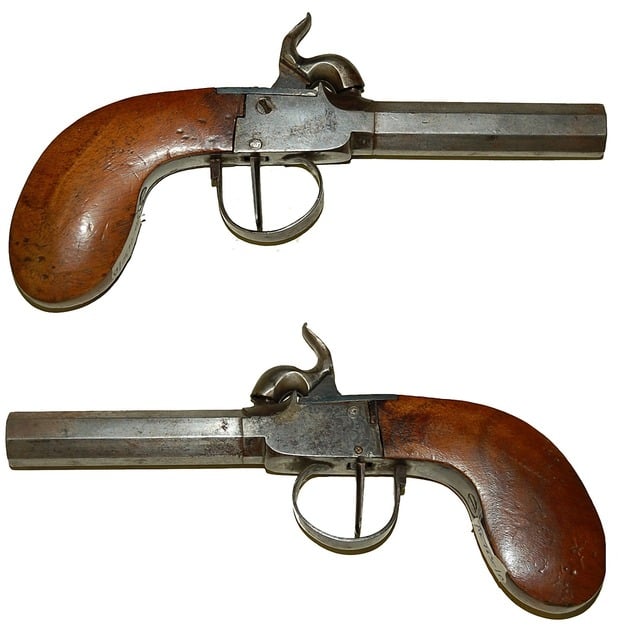

In the 1850s, dueling, despite its illegality, was not an uncommon way to settle disputes. Duels frequently involved high-ranking officials including US and state senators, a California Supreme Court justice, several assemblymen, and other federal and state office holders. Marin County was the site of several duels. This article describes two Marin encounters and a third that occurred elsewhere, but the survivor was tried in a Marin court.
Johnston vs. Ferguson
The duel between US Commissioner George Pen (Pendleton) Johnston and State Senator William I. Ferguson took place at Quarry Point on Angel Island on August 21, 1858. The duel was prompted by a barroom exchange where Ferguson supposedly insulted a female friend of Johnston's. Johnston called him a liar and Ferguson responded with a punch. Immediately after the incident, Johnston sent a formal challenge for a duel that Ferguson accepted. Ferguson later offered an apology but Johnston insisted the duel must go on.
Many held the belief that the true cause of the conflict between these men was a letter Ferguson had received from an associate of Johnston's containing provocative and scandalous charges. Ferguson, from time to time, had threatened to go public with the letter. When Johnston refused to accept an apology and to call off the duel, Ferguson was reported as saying, "Didn't I tell you so .... they are determined to get me out of the way --but, although he never fired a pistol in his life, 'Uncle Ferg' will give them the best fight he knows." Unfortunately, on the second round of shots, Ferguson was mortally wounded and died three weeks later on September 14, 1858, at 34 years old. He was buried in the Sacramento City Cemetery under a monument erected by the State of California.
A Marin County Grand Jury indicted Johnston for dueling. He was tried in the Marin Court of Sessions on November 9, 1858. Ironically, in 1857, it was Johnston, as an assemblyman, who had drawn up and advocated a law to increase the penalty for dueling. Under this law a survivor of a duel, if convicted, faced a sentence of one to seven years in state prison.
Johnston's defense presented medical testimony that Ferguson's duel-inflicted wound was not the cause of his death. Despite this improbable evidence, the Marin jury returned a verdict of not guilty. The Daily Alta California opined, "It [the verdict] constitutes a farcical termination to a bloody tragedy .... "
Johnston was said to be a changed man following the duel. He eventually took an
interest in the San Francisco Evening Examiner and led its development to become the leading Democratic newspaper on the West Coast. Johnston died in 1884, was eulogized at Grace Cathedral, and buried at the Masonic Cemetery in San Francisco. The Daily Alta California (March 3, 1884) took note of his passing, "He was kind and affable in his disposition, brave as a lion, sympathetic in his nature, and died probably without leaving an enemy on earth."
Broderick vs. Terry
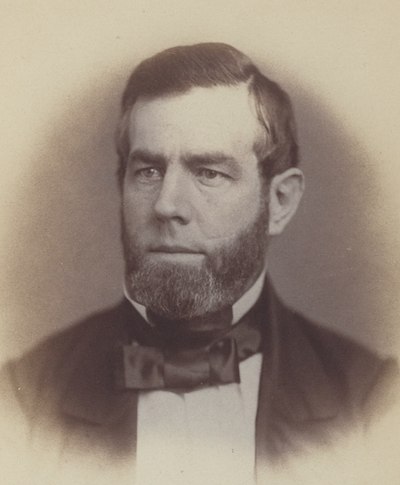
David C. Broderick, 1820-1859
In an unusual coincidence, another Bay Area duel between public officials also involved a senator killed over political differences just one year after the death of Senator Ferguson.
U. S. Senator David Colbreth Broderick was shot and killed in a duel near Lake Merced on September 16, 1859. The survivor was David S. Terry, a justice of the California Supreme Court. This duel between a US senator and a state supreme court justice has been called the last notable American duel.
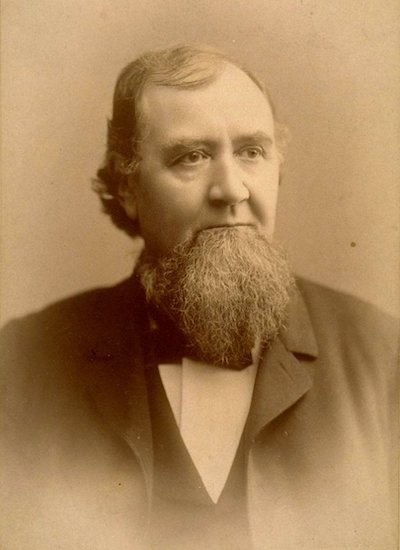
David S. Terry, 1823-1889
The years before the Civil War were a time of extreme tension between supporters of slavery and Union advocates. Broderick was a pro-Union abolitionist while Terry was a leader in the pro-slavery "Chivalry" wing of the California Democratic Party. Chivalry believed if Broderick was out of the way, the party could sweep the elections in 1859.
Hostile comments about Broderick, in a speech Terry delivered at the 1859 anti-slavery Democratic Convention, appeared to be the immediate cause of the duel. When Broderick learned of this speech he called Terry a "damned miserable ingrate .... ) have hitherto spoken of him as an honest man-but now I find I was mistaken. I take it all back .... " Broderick informed Terry that he would not apologize for these remarks. In
response Terry felt obligated to settle the matter in duel. As custom would have it, he issued a formal challenge.
Both men were known to be first-rate shots. However, Broderick was not aware that the pistol he chose, from those provided by Terry, had a delicate hair trigger. The weapon discharged prematurely and his shot hit the ground just a few feet in front of his position. In response Terry fired a shot piercing Broderick's chest and the senator died three days later. The senator was treated as a hero and a martyr for his fight against slavery.
San Francisco Police Detective H. H. Ellis described the arrest of Terry: "When we
arrived within about 100 feet of the [Terry's] house, a window was thrown open and
[several friends) and Terry leveled shotguns at us and told us to halt. ... He stated that he was certain that he would not receive a fair trial and feared violence at that time, but he agreed to surrender three days afterward in Oakland .... He surrendered as per agreement, and the case was heard by Judge James Hardy in Marin County, a change of venue having been granted because of the alleged prejudice against Terry in San Francisco. This case was dismissed but Terry was subsequently indicted by the Grand Jury in San Mateo County."
The case in San Mateo placed Terry in double jeopardy, so it was also dismissed. Terry went on to serve with distinction in the Confederate Army. He rose to the rank of brigadier general in charge of a brigade from Texas. In 1889, he was gunned down after threatening the life of Supreme Court Justice Stephen Field.
Piercy vs. Showalter
The last politically motivated duel in California was held in Fairfax on May 25, 1861, at the site of the former Marin Town and Country Club.
Again, Civil War fervor was the source of the antagonism-this time between Charles Wesley Piercy, a Union supporter, and Daniel Showalter, a secessionist. In 1861 Showalter, as an assemblyman, voted against a resolution for California to remain in the Union. The resolution passed but Showalter maintained Piercy had prevented him from saying why he was opposed to it. The two men argued and Piercy challenged him to a duel.
The duel was fought with rifles at 40 yards distance. Both men fired and missed but, on the second attempt, Piercy was killed by a shot to his mouth that broke his neck. Piercy's views were popular and he was regarded as a patriot and a gentleman. The Daily Alta California noted "he has given up his life in defense of a principle-loyalty to the Union."
To avoid trial, Showalter fled to southern California where he joined a group of fellow secessionists. His plan to join the Confederacy was thwarted when he was caught by the Union Army and sent to the military prison at Fort Yuma. He was released soon after pledging loyalty to the Union. His pledge notwithstanding, he was appointed lieutenant colonel in the cavalry and fought to oust Union soldiers from Texas.
Later Colonel Showalter was relieved of his command for drunkenness and fled to Mexico where he died at Mazatlan in 1866. Oddly, his death was due to lockjaw that some reports said he had contracted in a bar fight.
Society in the nineteenth century accepted a distinction between dueling and murder. Today, dueling is regarded as synonymous with murder, attempted murder, or conspiracy to commit murder. For decades laws prohibiting dueling were no longer needed, but it wasn't until 1994 that the California laws were finally repealed.