
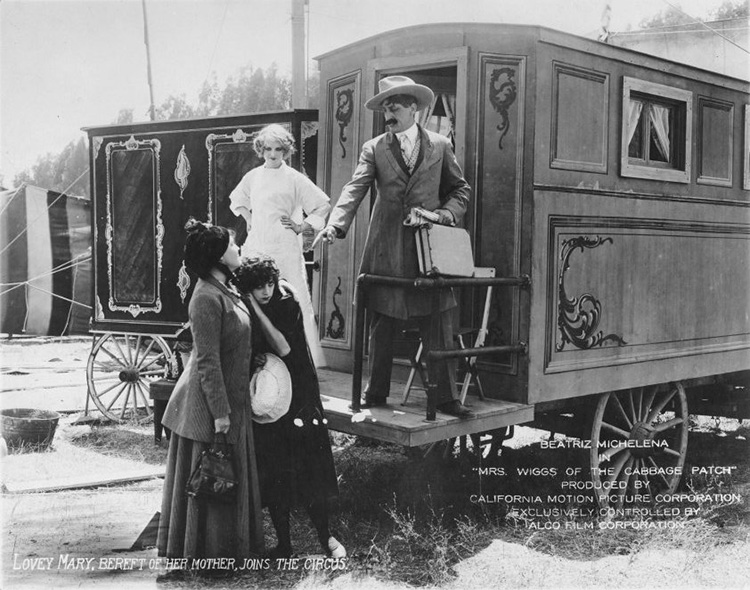

Beatriz Michelena, second from the
left, in a promotional photograph for
the 1914 film
Mrs. Wiggs of the Cabbage Patch.
When talking about early motion-picture filmmaking most people would not think, “Oh, yeah, San Rafael!” But in 1914, San Rafael’s Sun Valley neighborhood became the home to one of the premier movie-making studios of the young film industry. The California Motion Picture Corporation was the brainchild of Comstock mining heir, Herbert Payne, a self-described “clubman,” “capitalist,” and early automobile enthusiast. The previous year, Payne had driven from San Francisco to Los Angeles filming the beautiful landscape and historical attractions of the Golden State. He produced a film series titled, “The Golden Gate Weekly” that played in the Pantages and Orpheum theaters throughout the United States and Canada.
Payne understood the unique opportunity that film could provide in reaching a national audience to promote tourism and business opportunities in California.
A partner in the firm and prominent San Francisco automobile dealer, George Middleton, became a manager of the company and directed a number of the studio’s films. In 1907 he met, courted, and married Beatriz Michelena, a beautiful and exotic opera prima donna of the San Francisco stage. It was Michelena’s star power that transformed the studio from a promotional and advertising firm to one of the earliest and most prominent feature-length film studios.
Payne understood the unique opportunity that film could provide in reaching a national audience to promote tourism and business opportunities in California.
A partner in the firm and prominent San Francisco automobile dealer, George Middleton, became a manager of the company and directed a number of the studio’s films. In 1907 he met, courted, and married Beatriz Michelena, a beautiful and exotic opera prima donna of the San Francisco stage. It was Michelena’s star power that transformed the studio from a promotional and advertising firm to one of the earliest and most prominent feature-length film studios.
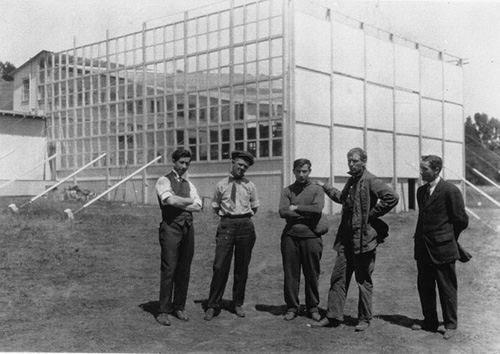
CMPC crewmembers outside glass-walled film stage in San Rafael
Moving from their San Francisco offices, Payne and Middleton chose San Rafael as a prime location to build their studio.
Not only was the site close to numerous natural environments in which to film, there was also ample sunlight throughout year; an
absolute necessity in the early days of film before interior lighting technology had been developed. The studio was built on land between present-day Forbes and 5th Avenues and J & K streets.
There was a large two-story building devoted to offices and dressing rooms, stables for horses and stagecoaches, a carpenter shop and prop storage warehouse, a film processing laboratory and vault, and a “cooks” building that served as both the kitchen and lunchroom for employees. Most impressive, and quite unique for the era, was the large, glass-walled and roofed film stage that let in light but not wind. This meant that the filming of interior scenes would not be plagued by gusts of wind that blew the actor’s clothing and hair or lightweight props such as tablecloths and curtains.
Another innovation pioneered by the company was the filming of interior scenes at remote locations. The studio constructed the shell of buildings minus a roof and one side that were covered by white sheets and “light diffusers” so that interior filming could be done without traveling back to the studio.
There was a large two-story building devoted to offices and dressing rooms, stables for horses and stagecoaches, a carpenter shop and prop storage warehouse, a film processing laboratory and vault, and a “cooks” building that served as both the kitchen and lunchroom for employees. Most impressive, and quite unique for the era, was the large, glass-walled and roofed film stage that let in light but not wind. This meant that the filming of interior scenes would not be plagued by gusts of wind that blew the actor’s clothing and hair or lightweight props such as tablecloths and curtains.
Another innovation pioneered by the company was the filming of interior scenes at remote locations. The studio constructed the shell of buildings minus a roof and one side that were covered by white sheets and “light diffusers” so that interior filming could be done without traveling back to the studio.
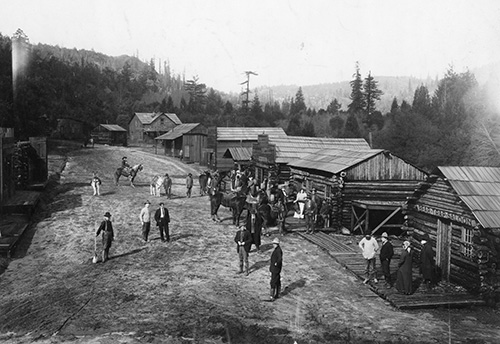
CMPC built this entire western town set in the Santa Cruz Mountains to film Salomy Jane
They also used an expensive Bell & Howell movie camera that held two reels of film along with another camera to film from a different direction, distance, or angle. Payne and Middleton along with their glamorous leading lady wanted to produce high quality, historically accurate movies based on classic tales and early California stories.
They chose for their first “filmatization,” a Bret Harte short story, “Salomy Jane’s Kiss,” a western romance that was released as Salomy Jane. Michelena’s natural beauty and acting experience gave her the tools to make the transition to silent film and, for a time, rival the popularity of silent film star Mary Pickford. Michelena was also an accomplished equestrian and strong swimmer, two skills that would prove invaluable, and often dangerous. Salomy Jane was released in late 1914 to a limited, nationwide audience having first screened at the St. Francis Hotel.
They chose for their first “filmatization,” a Bret Harte short story, “Salomy Jane’s Kiss,” a western romance that was released as Salomy Jane. Michelena’s natural beauty and acting experience gave her the tools to make the transition to silent film and, for a time, rival the popularity of silent film star Mary Pickford. Michelena was also an accomplished equestrian and strong swimmer, two skills that would prove invaluable, and often dangerous. Salomy Jane was released in late 1914 to a limited, nationwide audience having first screened at the St. Francis Hotel.
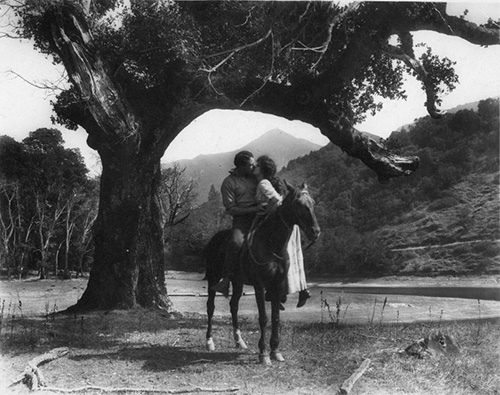
Beatriz Michelena and her leading man, House Peters, in 1914’s Salomy Jane
Josephine Clifford McCracken, a noted California writer and contemporary of Bret Harte, wrote, “… a girl with a wealth of
artistic tradition behind her, Michelena's gifts do not stop there. She has rare beauty, vivacity, wit, intellectual attainments and
athletic grace." The film was an artistic and critical success for the studio but did not turn a profit due to its limited distribution.
Michelena herself garnered praise for her acting and her ability to perform most of her stunts. Incredibly, she was knocked unconscious twice during her film career, once falling from a horse and once as she was being “rescued” by her male co-star and was dropped, hitting her head on a tree stump. She also survived two near-drownings when swimming in the flood-stage Russian River and the Santa Cruz Mountains near Boulder Creek. Adding to her fame, she wrote a newspaper advice column titled, "Talks with Screen-struck Girls,” for her younger fans and newspaper articles on film production and screen acting.
Between 1914 and 1916 the studio released eight more films including Mignon, a story based on three Brett Hart poems: “The Lily of Poverty Flat,” a Bret Hart story filmed mostly in the Santa Cruz Mountains near Boulder Creek; A Phyllis of the Sierras, filmed along the Russian River; Salvation Nell, a popular Edward Sheldon Play; Mrs. Wiggs of the Cabbage Patch, from a popular novel of the era; The Unwritten Law; and The Woman Who Dared.
Newspapers at the time gave most of these films rave reviews for their authenticity of character, sets, wardrobe, and action sequences. However, the company could never cover the costs of their extravagant productions. The studio declared bankruptcy in early 1917 after a failed attempt to bring the German drama, Faust, to the screen. Movie audiences were beginning to prefer the shorter, fast-paced comedies and westerns that were being churned out in Hollywood. The studio could not compete with their Southland competitors whose films were being distributed widely throughout the United States.
Between 1914 and 1916 the studio released eight more films including Mignon, a story based on three Brett Hart poems: “The Lily of Poverty Flat,” a Bret Hart story filmed mostly in the Santa Cruz Mountains near Boulder Creek; A Phyllis of the Sierras, filmed along the Russian River; Salvation Nell, a popular Edward Sheldon Play; Mrs. Wiggs of the Cabbage Patch, from a popular novel of the era; The Unwritten Law; and The Woman Who Dared.
Newspapers at the time gave most of these films rave reviews for their authenticity of character, sets, wardrobe, and action sequences. However, the company could never cover the costs of their extravagant productions. The studio declared bankruptcy in early 1917 after a failed attempt to bring the German drama, Faust, to the screen. Movie audiences were beginning to prefer the shorter, fast-paced comedies and westerns that were being churned out in Hollywood. The studio could not compete with their Southland competitors whose films were being distributed widely throughout the United States.