
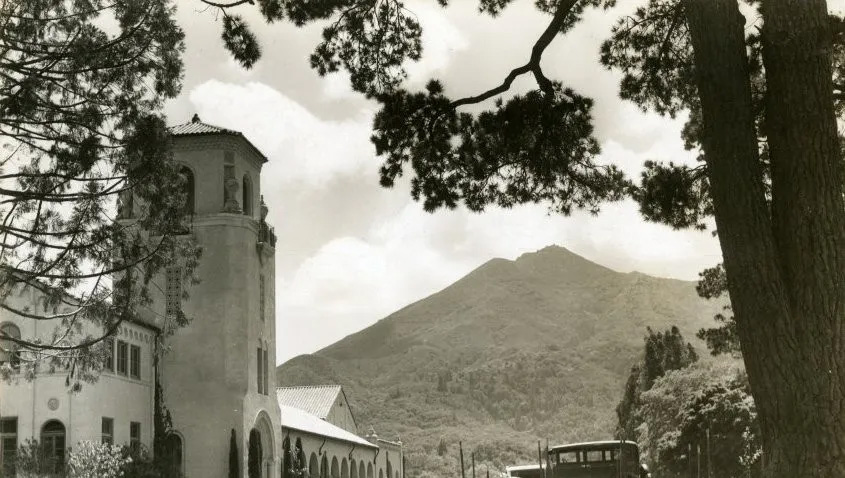

Marin Junior College’s Harlan Hall in the 1930s. (Marin History Museum Collection)
In 1926, Calvin Coolidge was the United States’ 30th president, U.S. Route 66 was established, actor Rudolph Valentino and biologist Luther Burbank died, Marilyn Monroe and future San Francisco icon Tony Bennett were born, Ernest Hemingway published “The Sun Also Rises,” A.A. Milne released “Winnie-the-Pooh” and Babe Ruth set a World Series record with three home runs.
Republican C.C. Young was elected the 26th governor of California, the undefeated Cal Bears basketball team ranked No. 1 in the nation, Marin County had fewer than 5,000 residents, a fire on Mount Tamalpais raged for two days and the Marin County Fair — held in Novato — featured horse racing and trick riding.
It was also the year the Marin Junior College was founded, later known as the College of Marin (COM).
Acting in response to a 1921 law that authorized high schools to set up junior college districts, the Tamalpais Union High School District launched a college initiative in 1923. It was joined by the San Rafael High School District, and in March 1925 Marin County residents voted 2-to-1 in favor of creating the school. Led by George Harlan, the president of the board of trustees, the Tam District initially leased the 13-acre Butler tract in Kentfield for the campus. The Butler mansion was divided into eight classrooms, and the adjoining barn became the gymnasium. Six faculty members were hired: Gerda Oberland (English), Ethel Cobb (biology), Paul Maher (math and physics), Murray Cuddeback (geology and physical education), Clyde Chenowith (history) and Henrietta Roumiguerre (Spanish and French).
A class of 87 students launched the college’s first semester in the fall of 1926 under the leadership of president A.C. Olney. In 1927, Elizabeth Thacher Kent deeded another 29 acres to the college, formerly a community recreation area. Sarsfield Manning became the first student body president and Stanley Moore, soon to become the school’s first graduate, issued the first official college publication. The science building was added in 1927, and the first commencement occurred in July 1928 at the Tam Center Auditorium. The Butler tract was also bought by the college later that year. In 1929, the administration building and tower went up, becoming the campus center, and was later renamed Harlan Hall.
In 1930, the college put on its first drama production, established its first intercollegiate football team and purchased another 10-acre property for the new gym, football field and tennis courts. In 1933, the Depression-era Civil Works Administration funded a mural that still survives in the zoology lab. Dickson Hall was added in 1935 to house the automotive, machine tool and engineering programs. An additional lot on the campus’s south end was bought in 1937, soon becoming the site for Olney Hall. In 1939, an adult school was added to the college to coordinate its ongoing adult classes, and the Ada Fusselman Library was completed.
During World War II, enrollment dipped, but the college offered military support and training, including courses at the Hamilton Army Airfield. The football field was converted into a cattle pasture and vegetable farm, and Butler Hall became a dormitory and cafeteria for the United States Army Signal Corps. In 1943, Olney resigned, having helped launch not only COM but also two of California’s first 10 junior colleges into existence. The presidency was turned over to Ward H. Austin, soon to be known as “Mr. Junior College.” In 1947, KTIM — Marin’s first community radio station — set up its first transmitter on campus. The school was renamed the College of Marin in 1948, when it also offered its first classes at San Quentin prison. The Marine Corps reserves also moved into three Quonset huts on campus, adjoining the baseball field.
Unlike the previous war, the Korean War did little to disrupt the campus, and both enrollment numbers and construction escalated in the early 1950s. The grand but tired Butler mansion gave way to a new fine arts building in 1950, and the dilapidated Butler Barn came down the following year. The school gained accreditation in 1953 by the Western Association of Schools and Colleges, the same year the COM football team became the Golden Valley Conference co-champions. The last survivor of the original board of trustees, Ada Fusselman, retired in 1959, having had a hand in every decision for 33 years.
Republican C.C. Young was elected the 26th governor of California, the undefeated Cal Bears basketball team ranked No. 1 in the nation, Marin County had fewer than 5,000 residents, a fire on Mount Tamalpais raged for two days and the Marin County Fair — held in Novato — featured horse racing and trick riding.
It was also the year the Marin Junior College was founded, later known as the College of Marin (COM).
Acting in response to a 1921 law that authorized high schools to set up junior college districts, the Tamalpais Union High School District launched a college initiative in 1923. It was joined by the San Rafael High School District, and in March 1925 Marin County residents voted 2-to-1 in favor of creating the school. Led by George Harlan, the president of the board of trustees, the Tam District initially leased the 13-acre Butler tract in Kentfield for the campus. The Butler mansion was divided into eight classrooms, and the adjoining barn became the gymnasium. Six faculty members were hired: Gerda Oberland (English), Ethel Cobb (biology), Paul Maher (math and physics), Murray Cuddeback (geology and physical education), Clyde Chenowith (history) and Henrietta Roumiguerre (Spanish and French).
A class of 87 students launched the college’s first semester in the fall of 1926 under the leadership of president A.C. Olney. In 1927, Elizabeth Thacher Kent deeded another 29 acres to the college, formerly a community recreation area. Sarsfield Manning became the first student body president and Stanley Moore, soon to become the school’s first graduate, issued the first official college publication. The science building was added in 1927, and the first commencement occurred in July 1928 at the Tam Center Auditorium. The Butler tract was also bought by the college later that year. In 1929, the administration building and tower went up, becoming the campus center, and was later renamed Harlan Hall.
In 1930, the college put on its first drama production, established its first intercollegiate football team and purchased another 10-acre property for the new gym, football field and tennis courts. In 1933, the Depression-era Civil Works Administration funded a mural that still survives in the zoology lab. Dickson Hall was added in 1935 to house the automotive, machine tool and engineering programs. An additional lot on the campus’s south end was bought in 1937, soon becoming the site for Olney Hall. In 1939, an adult school was added to the college to coordinate its ongoing adult classes, and the Ada Fusselman Library was completed.
During World War II, enrollment dipped, but the college offered military support and training, including courses at the Hamilton Army Airfield. The football field was converted into a cattle pasture and vegetable farm, and Butler Hall became a dormitory and cafeteria for the United States Army Signal Corps. In 1943, Olney resigned, having helped launch not only COM but also two of California’s first 10 junior colleges into existence. The presidency was turned over to Ward H. Austin, soon to be known as “Mr. Junior College.” In 1947, KTIM — Marin’s first community radio station — set up its first transmitter on campus. The school was renamed the College of Marin in 1948, when it also offered its first classes at San Quentin prison. The Marine Corps reserves also moved into three Quonset huts on campus, adjoining the baseball field.
Unlike the previous war, the Korean War did little to disrupt the campus, and both enrollment numbers and construction escalated in the early 1950s. The grand but tired Butler mansion gave way to a new fine arts building in 1950, and the dilapidated Butler Barn came down the following year. The school gained accreditation in 1953 by the Western Association of Schools and Colleges, the same year the COM football team became the Golden Valley Conference co-champions. The last survivor of the original board of trustees, Ada Fusselman, retired in 1959, having had a hand in every decision for 33 years.
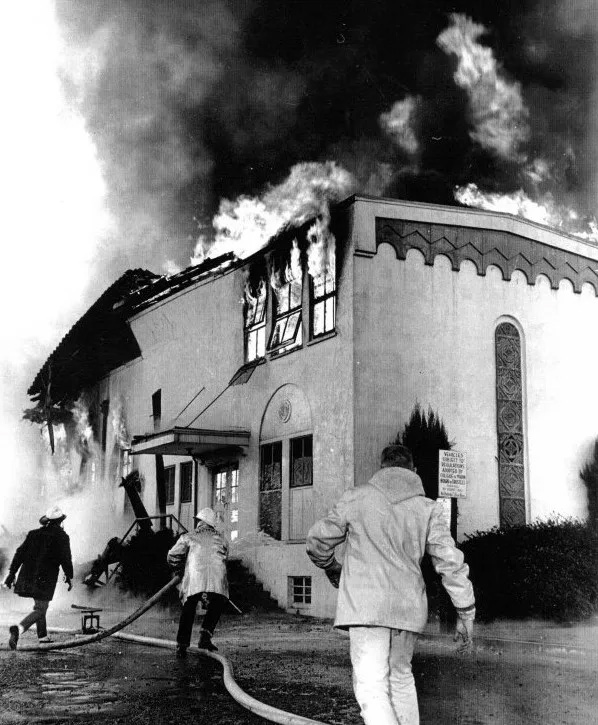
A fire destroyed the College of Marin's gymnasium in 1963. (Marin History Museum Collection)
The next year, 1960, marked Austin’s retirement, ending an unlikely trajectory. As a young professor at the University of California at Berkeley, he wrote a 1925 paper claiming Marin County’s inadequate tax base couldn’t support a junior college. When it happened anyway, Austin joined the COM engineering faculty two years later and then became the president — for 17 years — of the institution he had once deemed impossible. As Jonathan Eldridge, College of Marin’s current president, has observed, “Austin’s journey from skeptic to champion embodies the spirit that has defined our college for a century: the willingness to challenge assumptions, embrace possibility and dedicate ourselves to educational excellence even when the odds have been stacked against us.”
Responding to a new demand for a more coherent and personalized education, the 1960s began a new expansion initiative at COM. It also had to accommodate a new influx of students, now more than 2,500 by 1962. The college survived a threat in 1963, when the gymnasium caught fire. Crews from several surrounding towns rushed to the site, and the 50 firefighters were even aided by COM students. But nothing could be done to save the building and its contents. Arson was initially suspected, but the fire was ultimately ruled accidental, likely caused by a portable electric heater. In 1965, the Irwin P. Diamond Physical Education Center replaced the old gym.
Harlan Hall was razed in 1969 and replaced by the Harlan Center. The Indian Valley campus in Novato was established in 1971. It operated at the Hamilton Air Force Base and the Pacheco School until the new campus was opened in 1975. The two colleges formally merged in 1985, adding Novato’s 333 acres to Kentfield’s existing 77 acres.
In the early years as well as in more recent times, COM has produced many famous alumni: NFL football coach Pete Carroll; primatologist Dian Fossey; singer-songwriter Naomi Judd; Marin District Attorney Lori Frugoli; Life360 founder Chris Hulls; MLB pitcher Art Schallock; and actor-comedian Robin Williams. COM’s impact can perhaps most dramatically be seen in the experience of another alumnus, NASA engineer Adam Steltzner, who described himself as “listless” before taking a “life-changing” astronomy course at the College of Marin with Stephen Prata.
The College of Marin accomplished a great deal in its first 50 years, and 2026 will be a yearlong celebration of that history and its even more impressive second-half century, which will be covered in these pages in the months ahead. A 100th anniversary time capsule is being prepared, a Founder’s Day celebration will be held from 11 a.m. to 2 p.m. April 6 and a Kentfield campus showcase will run from May 4 through 9. More information at marin.edu.
Whenever Eldridge speaks to groups in Marin, he asks: “Who in the room has attended or had a family member attend the College of Marin?” Invariably, most hands go up in the room. “Each one has a College of Marin story to tell.”
History Watch is written by Robert Elias, a volunteer with the Marin History Museum. Elias is also an emeritus professor of politics at the University of San Francisco and editor of the Mill Valley Historical Society Review.
Responding to a new demand for a more coherent and personalized education, the 1960s began a new expansion initiative at COM. It also had to accommodate a new influx of students, now more than 2,500 by 1962. The college survived a threat in 1963, when the gymnasium caught fire. Crews from several surrounding towns rushed to the site, and the 50 firefighters were even aided by COM students. But nothing could be done to save the building and its contents. Arson was initially suspected, but the fire was ultimately ruled accidental, likely caused by a portable electric heater. In 1965, the Irwin P. Diamond Physical Education Center replaced the old gym.
Harlan Hall was razed in 1969 and replaced by the Harlan Center. The Indian Valley campus in Novato was established in 1971. It operated at the Hamilton Air Force Base and the Pacheco School until the new campus was opened in 1975. The two colleges formally merged in 1985, adding Novato’s 333 acres to Kentfield’s existing 77 acres.
In the early years as well as in more recent times, COM has produced many famous alumni: NFL football coach Pete Carroll; primatologist Dian Fossey; singer-songwriter Naomi Judd; Marin District Attorney Lori Frugoli; Life360 founder Chris Hulls; MLB pitcher Art Schallock; and actor-comedian Robin Williams. COM’s impact can perhaps most dramatically be seen in the experience of another alumnus, NASA engineer Adam Steltzner, who described himself as “listless” before taking a “life-changing” astronomy course at the College of Marin with Stephen Prata.
The College of Marin accomplished a great deal in its first 50 years, and 2026 will be a yearlong celebration of that history and its even more impressive second-half century, which will be covered in these pages in the months ahead. A 100th anniversary time capsule is being prepared, a Founder’s Day celebration will be held from 11 a.m. to 2 p.m. April 6 and a Kentfield campus showcase will run from May 4 through 9. More information at marin.edu.
Whenever Eldridge speaks to groups in Marin, he asks: “Who in the room has attended or had a family member attend the College of Marin?” Invariably, most hands go up in the room. “Each one has a College of Marin story to tell.”
History Watch is written by Robert Elias, a volunteer with the Marin History Museum. Elias is also an emeritus professor of politics at the University of San Francisco and editor of the Mill Valley Historical Society Review.
This article appeared in the Marin Independent Journal on March 19, 2026