
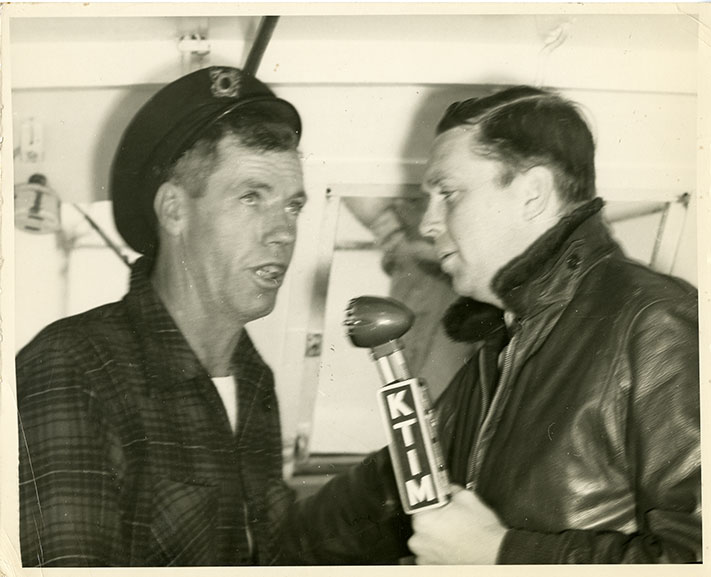

Hugh Turner's "Man in the Street" interview. Marin History Museum Collection.
Despite its many audio and video challengers, radio has survived and flourished in the U.S. for more than a century. From its beginnings in the early 1920s, the Golden Age of Radio had already emerged by the late 1920s and early 1930s. The early history began with commercial radio; that is, stations with paid staff and a regional audience, supported by advertising revenue. In contrast, the first U.S. non-commercial public radio station, supported by listeners, didn’t emerge until 1949, when Berkeley’s KPFA and affiliates began programming a national content to a national audience.
Supplementing commercial and public radio, community radio stations typically operated with a volunteer or low-wage staff, focusing on local issues, and featuring a limited broadcast signal. On May 1, 1947, Marin County got its first community station after the FCC licensed KTIM in San Rafael at 1510 on the AM dial. Operating at 1,000 watts from a transmitter in a Kentfield salt marsh near the College of Marin, the station originally opened at 1117 Fifth Street at B Street. To accommodate KTIM, a family vacated that address and years later a boy appeared at the station claiming the control room had once been his bedroom.
Officially known as the Marin Broadcasting Company, KTIM was owned by the Independent Journal and run by Ernest L. Smith. The station began taking off in June 1948 when KLS and KGO veteran, Hugh Turner, bought out Smith and became KTIM’s general manager. A future Novato mayor, Turner--with the help of his wife, Juanita, ran the station for the next 30 years. Allan Johnstone was the commercial manager and Mark Gerstle was the chief announcer.
In the early days, KTIM-AM provided “full-service radio,” with some music, but primarily local news, issues, sports, interviews, call-ins, and some religious content. Operating solely in daytime hours, announcer Paul Chappel opened each day at 7 a.m. with the Ranch Report. Other programs included Yawn Patrol, Coffee Club, North Bay Rhythm Ranch, Inquiring Parent, Women’s Page, Welcome Wagon, Lets Go to the Movies, Aunt Ginny & Lil Tim, and the Evening Serenade.
Hugh Turner covered news, features, and his “Man in the Street” interviews (see photo). His wife Juanita hosted in-studio interviews for “Turner Time.” The Marin IJ’s Charlotte Riznik read the “Newspaper of the Air” three times daily. The “Doctor of Jazz,” Ollie Freeman ran the “Jazzland” show from KTIM’s Richmond studio. David Chasuk played classical music. Curly Burns had a western music show and Earl Grady played folk songs. “Tam Time” featured a teenage DJ with teen tunes. Agnello Clementino ran a foreign language program, the Portuguese Voice of Marin. Sundays featured extensive religious programming and some live, local performances, such as the Lonely Four Quartet. Each day ended with a Sign Off show at 8:15 pm.
By the mid-1950s, KTIM was airing more music, including popular tunes from the 1930s and 1940s, and two hours daily of classical music. The station relocated to the old IJ building at 1040 B Street in San Rafael in 1957 and KTIM’s transmitter moved nearby in 1960. The next year, the station began simulcasting its AM programming to KTIM-FM on the 100.9 frequency. KTIM retained its traditional MOR (middle of the road) format until Clint Weyrauch (see photo) joined the station in 1969. Initially, Clint hosted remote classical shows, wrote copy, read obits, sold air time, and then was loaned out to sister station, KBLC, in Lakeport. But in 1971, back at KTIM, the 23-year-old Weyrauch convinced Hugh Turner to shake up the station from its old-fashioned content with a progressive rock program. “The Show” ran Mondays through Thursdays from 8 pm to midnight and dramatically changed KTIM’s sound and culture.
Playing songs from his 1,000 albums dating back to 1955, Weyrauch began taking the station from easy listening love songs to more hard-driving music with new depth and social messages. KTIM promoted the show by giving away a Magic Mountain waterbed. With the program an instant success, the station began showing a profit for the first time.
While KTIM-AM initially retained its traditional approach, Weyrauch’s show evolved on KTIM-FM to a 24/7 rock format by 1973. After the Turners left the station to run KPLS in Santa Rosa, KTIM-AM began simulcasting the rock programming in 1975. Soon dubbed the “North Bay Noise,” KTIM attracted a series of young DJs and the programming transitioned to album-centered, “freeform” music. Having worked briefly myself as a DJ in the 1980s for the community radio station, WMFO, run out of Tufts University in Medford, Massachusetts, I was familiar with the new format.
Rather than featuring a single, dedicated genre for each show, freeform music sought to creatively blend a wide range of musical styles, including rock, blues, country, jazz, folk, reggae, classical, new wave, R&B, oldies, comedy, and imports. How could you seamlessly transition, for example, from Bob Marley’s reggae to Mozart’s 5th to John Coltrane’s jazz? Playing “radio roulette,” DJs would sometimes pick a song and challenge each other to play the best segue. With pre-programmed radio sweeping the nation elsewhere, KTIM staff began describing themselves as “The Last Free Radio Station.” Rather than having playlists imposed on them, KTIM DJs controlled the music they played, offering a much wider exposure of new music. Soon their record collection blossomed to 10,000 albums.
With Weyrauch as Program Director and Tony Beradini as Music Director, the on-air staff included Paul Boucher, Joe Collins, Candi Chamberlain, Frank Forest, Paul Grosso, Wild Bill Scott, Cody Scott, Chris Potter, Bill Richeson, Joyce Shank, Todd Tolces, David T, Doug Wendt, Doreen Nagle, and Mary Holloway, among others. Susie Davis ran live auditions of local bands on her “Sudden Exposure” show. Vikki Cunningham specialized in creative approaches to reporting the news. Future legend, Michael Krasny, hosted the “Beyond the Hot Tub” program. The “Flea Market of The Air” provided a classified service. Local merchants appreciated the DJs often-humorous takes on their commercial ads. Unusual interviews intrigued listeners and call-in programs intensified KTIM’s strong community connection.
By 1978, despite its album focus and weak signal (still only 2,200 watts), KTIM was providing serious competition to the large San Francisco stations, including KSAN (at 30,000 watts) and KMEL (at 69,000 watts). Besides its studios, the station launched popular broadcasts from the Marin County Fair each year and recorded and played live artists like Van Morrison and Jerry Garcia at venues such as the Lion’s Share in San Anselmo and Sweetwater in Mill Valley. KTIM featured songs that would never have been heard on the commercial stations, appealing to listeners and giving the new music a chance to take off. KTIM took risks on new bands, giving groups such as AC/DC, George Thorogood, and Pat Travers, their first start at the station. Other friends of the station included Huey Lewis and the News, Jefferson Airplane, George Winston, Bo Diddley, Boz Scaggs, Steve Miller, Sons of Champlin, and Chuck Mangione.
Describing the period as the “Revolution of A Radio Station,” Clint Weyrauch observed that “There’s a mystique about KTIM; an aura which is unique. KTIM can innovate; experiment; play previously unknown music and artists yet retain its strong audience figures. The station communicates with its audience in a very personal way.” But the excitement began to wane when Weyrauch left to manage KSPO in Spokane and Tony Bernardi departed for Boston to become the WBCN program director, both in 1978.
In 1980, KTIM was sold to Platt Communications and the AM-FM simulcast ended. In 1981 the studio was relocated to Heritage House at 1623 Fifth Avenue in San Rafael’s Victorian Village. A big band format took over in 1982 and the station was sold again to Arthur Astor, who replaced several DJs and then imposed soft rock and adult contemporary programming.
The late 1980s began a dizzying trajectory of changes in the next four decades: KTIM became KCAF in 1988 (country), KTID in 1989, KAPX in 1990 (adult standards), KKHI in 1994 (classical, with new owners Mount Wilson FM), KNOB in 1995 (Big Band jazz), KJQI in 1998 (adult standards), KMZT in 2000 (classical), KJAZ in 2001 (Christian), and back to KTIM in 2002 (country). But the call letters KMZT returned in 2003 (classical) and then in 2005 (oldies), simulcasting with KPIG-FM (progressive rock and alternative country). The station became KSFN in 2010, with a Chinese language format until 2019, when it adopted its current regional Mexican programming.
The original KTIM is long gone. Community radio in Marin hangs on, with KWMR-FM in Point Reyes Station (90.5), the internet Radio Sausalito AM (1610), and the tiny KDAN-FM (91.5) in Marshall. But old timers remember KTIM’s early days, launched by Hugh Turner, and then the excitement of the 1970s and early 1980s, sparked by Clint Weyrauch and a memorable gang of innovative DJs.
Robert Elias is emeritus professor of Politics at the University of San Francisco and editor of the Mill Valley Historical Society Review
Supplementing commercial and public radio, community radio stations typically operated with a volunteer or low-wage staff, focusing on local issues, and featuring a limited broadcast signal. On May 1, 1947, Marin County got its first community station after the FCC licensed KTIM in San Rafael at 1510 on the AM dial. Operating at 1,000 watts from a transmitter in a Kentfield salt marsh near the College of Marin, the station originally opened at 1117 Fifth Street at B Street. To accommodate KTIM, a family vacated that address and years later a boy appeared at the station claiming the control room had once been his bedroom.
Officially known as the Marin Broadcasting Company, KTIM was owned by the Independent Journal and run by Ernest L. Smith. The station began taking off in June 1948 when KLS and KGO veteran, Hugh Turner, bought out Smith and became KTIM’s general manager. A future Novato mayor, Turner--with the help of his wife, Juanita, ran the station for the next 30 years. Allan Johnstone was the commercial manager and Mark Gerstle was the chief announcer.
In the early days, KTIM-AM provided “full-service radio,” with some music, but primarily local news, issues, sports, interviews, call-ins, and some religious content. Operating solely in daytime hours, announcer Paul Chappel opened each day at 7 a.m. with the Ranch Report. Other programs included Yawn Patrol, Coffee Club, North Bay Rhythm Ranch, Inquiring Parent, Women’s Page, Welcome Wagon, Lets Go to the Movies, Aunt Ginny & Lil Tim, and the Evening Serenade.
Hugh Turner covered news, features, and his “Man in the Street” interviews (see photo). His wife Juanita hosted in-studio interviews for “Turner Time.” The Marin IJ’s Charlotte Riznik read the “Newspaper of the Air” three times daily. The “Doctor of Jazz,” Ollie Freeman ran the “Jazzland” show from KTIM’s Richmond studio. David Chasuk played classical music. Curly Burns had a western music show and Earl Grady played folk songs. “Tam Time” featured a teenage DJ with teen tunes. Agnello Clementino ran a foreign language program, the Portuguese Voice of Marin. Sundays featured extensive religious programming and some live, local performances, such as the Lonely Four Quartet. Each day ended with a Sign Off show at 8:15 pm.
By the mid-1950s, KTIM was airing more music, including popular tunes from the 1930s and 1940s, and two hours daily of classical music. The station relocated to the old IJ building at 1040 B Street in San Rafael in 1957 and KTIM’s transmitter moved nearby in 1960. The next year, the station began simulcasting its AM programming to KTIM-FM on the 100.9 frequency. KTIM retained its traditional MOR (middle of the road) format until Clint Weyrauch (see photo) joined the station in 1969. Initially, Clint hosted remote classical shows, wrote copy, read obits, sold air time, and then was loaned out to sister station, KBLC, in Lakeport. But in 1971, back at KTIM, the 23-year-old Weyrauch convinced Hugh Turner to shake up the station from its old-fashioned content with a progressive rock program. “The Show” ran Mondays through Thursdays from 8 pm to midnight and dramatically changed KTIM’s sound and culture.
Playing songs from his 1,000 albums dating back to 1955, Weyrauch began taking the station from easy listening love songs to more hard-driving music with new depth and social messages. KTIM promoted the show by giving away a Magic Mountain waterbed. With the program an instant success, the station began showing a profit for the first time.
While KTIM-AM initially retained its traditional approach, Weyrauch’s show evolved on KTIM-FM to a 24/7 rock format by 1973. After the Turners left the station to run KPLS in Santa Rosa, KTIM-AM began simulcasting the rock programming in 1975. Soon dubbed the “North Bay Noise,” KTIM attracted a series of young DJs and the programming transitioned to album-centered, “freeform” music. Having worked briefly myself as a DJ in the 1980s for the community radio station, WMFO, run out of Tufts University in Medford, Massachusetts, I was familiar with the new format.
Rather than featuring a single, dedicated genre for each show, freeform music sought to creatively blend a wide range of musical styles, including rock, blues, country, jazz, folk, reggae, classical, new wave, R&B, oldies, comedy, and imports. How could you seamlessly transition, for example, from Bob Marley’s reggae to Mozart’s 5th to John Coltrane’s jazz? Playing “radio roulette,” DJs would sometimes pick a song and challenge each other to play the best segue. With pre-programmed radio sweeping the nation elsewhere, KTIM staff began describing themselves as “The Last Free Radio Station.” Rather than having playlists imposed on them, KTIM DJs controlled the music they played, offering a much wider exposure of new music. Soon their record collection blossomed to 10,000 albums.
With Weyrauch as Program Director and Tony Beradini as Music Director, the on-air staff included Paul Boucher, Joe Collins, Candi Chamberlain, Frank Forest, Paul Grosso, Wild Bill Scott, Cody Scott, Chris Potter, Bill Richeson, Joyce Shank, Todd Tolces, David T, Doug Wendt, Doreen Nagle, and Mary Holloway, among others. Susie Davis ran live auditions of local bands on her “Sudden Exposure” show. Vikki Cunningham specialized in creative approaches to reporting the news. Future legend, Michael Krasny, hosted the “Beyond the Hot Tub” program. The “Flea Market of The Air” provided a classified service. Local merchants appreciated the DJs often-humorous takes on their commercial ads. Unusual interviews intrigued listeners and call-in programs intensified KTIM’s strong community connection.
By 1978, despite its album focus and weak signal (still only 2,200 watts), KTIM was providing serious competition to the large San Francisco stations, including KSAN (at 30,000 watts) and KMEL (at 69,000 watts). Besides its studios, the station launched popular broadcasts from the Marin County Fair each year and recorded and played live artists like Van Morrison and Jerry Garcia at venues such as the Lion’s Share in San Anselmo and Sweetwater in Mill Valley. KTIM featured songs that would never have been heard on the commercial stations, appealing to listeners and giving the new music a chance to take off. KTIM took risks on new bands, giving groups such as AC/DC, George Thorogood, and Pat Travers, their first start at the station. Other friends of the station included Huey Lewis and the News, Jefferson Airplane, George Winston, Bo Diddley, Boz Scaggs, Steve Miller, Sons of Champlin, and Chuck Mangione.
Describing the period as the “Revolution of A Radio Station,” Clint Weyrauch observed that “There’s a mystique about KTIM; an aura which is unique. KTIM can innovate; experiment; play previously unknown music and artists yet retain its strong audience figures. The station communicates with its audience in a very personal way.” But the excitement began to wane when Weyrauch left to manage KSPO in Spokane and Tony Bernardi departed for Boston to become the WBCN program director, both in 1978.
In 1980, KTIM was sold to Platt Communications and the AM-FM simulcast ended. In 1981 the studio was relocated to Heritage House at 1623 Fifth Avenue in San Rafael’s Victorian Village. A big band format took over in 1982 and the station was sold again to Arthur Astor, who replaced several DJs and then imposed soft rock and adult contemporary programming.
The late 1980s began a dizzying trajectory of changes in the next four decades: KTIM became KCAF in 1988 (country), KTID in 1989, KAPX in 1990 (adult standards), KKHI in 1994 (classical, with new owners Mount Wilson FM), KNOB in 1995 (Big Band jazz), KJQI in 1998 (adult standards), KMZT in 2000 (classical), KJAZ in 2001 (Christian), and back to KTIM in 2002 (country). But the call letters KMZT returned in 2003 (classical) and then in 2005 (oldies), simulcasting with KPIG-FM (progressive rock and alternative country). The station became KSFN in 2010, with a Chinese language format until 2019, when it adopted its current regional Mexican programming.
The original KTIM is long gone. Community radio in Marin hangs on, with KWMR-FM in Point Reyes Station (90.5), the internet Radio Sausalito AM (1610), and the tiny KDAN-FM (91.5) in Marshall. But old timers remember KTIM’s early days, launched by Hugh Turner, and then the excitement of the 1970s and early 1980s, sparked by Clint Weyrauch and a memorable gang of innovative DJs.
Robert Elias is emeritus professor of Politics at the University of San Francisco and editor of the Mill Valley Historical Society Review