
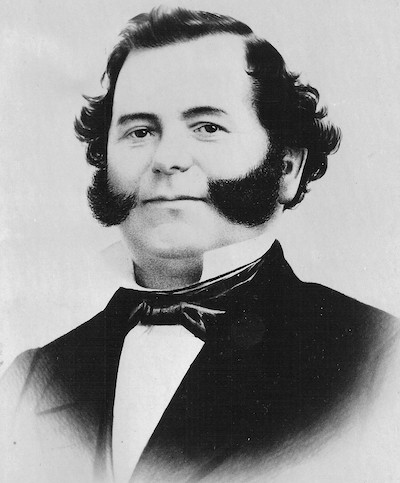

Don Mariano Guadalupe Vallejo, 1807-1890
Tt was June 28, 1846, a warm, pleasant summer day in San Rafael. The few residents of the sleepy little Mexican settlement were anxious. Word had reached them that a group of American settlers had attacked the army outpost at Sonoma. The tiny garrison had surrendered without a tight, and the rag-tag frontiersmen had seized the town. The genial and beloved General Mariano Vallejo, a supporter of American immigration, had invited the leaders into his home, offered them refreshments, and asked how he could resolve any differences. But the rebels seized General Vallejo and several of his family and supporters and sent them off under armed guard to Sutter's Fort. There were rumors they were being mistreated. The so-called Bear Flag Revolt consisted of hundreds of American ranchers and farmers, but no one knew who was in charge. They had no official sanction from the far-away United States government. The Governor of California, Jose Castro, had begun gathering soldiers and volunteers at the capital in Monterey to put down the rebellion, but it was uncertain how far his preparations had gotten or where he was. There were rumors of scattered fighting and even of atrocities being committed.
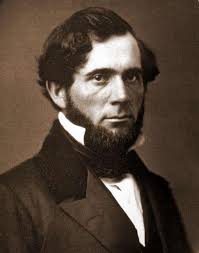
John C. Frémont, 1813-1890
Only the day before, the people were startled when a company of 130 Americans had ridden down the road from Petaluma and stormed into town. They found only four old non-combatant men defended the town. The Americans were a surveying expedition commanded by Captain John C. Frémont 1 and had been mapping northern California-without the permission of the Mexican government. Frémont was famous throughout both countries as an explorer, but also as something of a hothead. He traveled with a group of Pawnee and Delaware Indians who were devoted to him and would do anything he ordered, including killing. Only a few months earlier, he had camped near Monterey and publicly declared that if war broke out with Mexico, he would set himself up as the military governor of the province. Governor Castro had mustered his army, and Frémont, knowing he had no authority, had quickly fled back into the northern wilderness. The previous month, after an Indian attack on his expedition, he had attacked the first Indian village he encountered and massacred every inhabitant.
When Frémont learned of the attack on Sonoma, he had rushed to the town and, without orders or authorization, had assumed control of the town and the rebellion. He formed a new military unit, the California Battalion, and enlisted all the rebels into the U. S. Army. They took up defensive positions around Sonoma but had a miniscule amount of gunpowder. William Todd 2 and an unnamed Englishman were sent to Moses Carson's ranch on Bodega Bay to find some, and two others-Thomas Cowie and George Fowler-went to Healdsburg for the same purpose. But none of them returned.
General Castro sent a company of troops north from Monterey under the command of Lieutenant Joaquin de la Torre to relieve Sonoma. They had arrived in San Rafael by boat, then started north up the road to Petaluma. They stopped for breakfast at the rancho at Olompali, owned by the Indian Camilo Ynitia. When Fremont's "troops" coming south approached the rancho, the two parties, equally surprised, began firing. During the fighting, a man ran out of the buildings to the American lines. He was William Todd, the man sent to Bodega Bay for gunpowder. A Mexican woman in the house had cut his bonds. He told them he, his English companion, Cowie, and Fowler had all been captured. De la Torre withdrew back through San Rafael with the Americans in pursuit. Eight Californian troops (some accounts say only one) and the unnamed English prisoner were killed and two others wounded, but reportedly no Americans were injured. The Californians had better horses and quickly gained a long head-start. De la Torre cleverly wrote a note, addressed to their imprisoned countrymen in Sonoma, saying that General Castro and a considerable force was only a few hours from Sonoma. He gave this note to an old Indian and told him to go north and allow himself to be captured by the Americans. This was done, and when Frémont read the note, he abandoned the pursuit and rushed to Sonoma to defend the town. The Bear Flaggers heard their approach and stood ready with matches to their cannon, but at the last moment one of Frémont's men called out that they were friends.
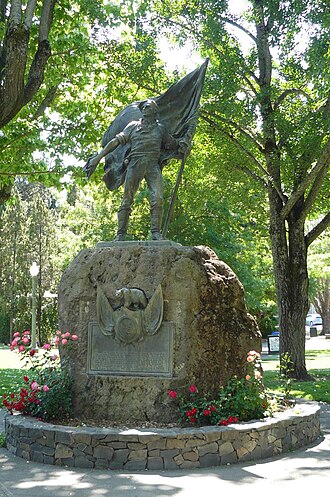
Bear Flag Monument, Sonoma
Meanwhile, De la Torre reached Sausalito and found a boat sufficient to take the whole company safely back to the presidio on the San Francisco side 3 The only battle of the Bear flag Revolt was over, with both sides claiming victory.
When the Americans had been pursuing the Californians toward San Rafael, they came upon a horrible sight. The bodies of Cowie and Fowler were found in a ditch beside the road, their tongues cut out, disemboweled, and horribly mutilated. The Americans were furious and vowed revenge. When the expected attack on Sonoma did not occur,
Frémont returned to Marin determined to cross to the presidio of San Francisco and capture it. When he reached Olompali again, he camped and sent a messenger to William Richardson at Sausalito requesting fresh horses. Richardson sent his fifteen-year-old son Stephen with a small herd of horses.
When the American soldiers rode into San Rafael that June day, the Californian and Miwok residents trembled in fear. There were not many of them. There was only one house, that of Don Timoteo Murphy. 4 The mission had been closed two years before and the old buildings stood abandoned. There were no priests or soldiers to defend the citizens. Frémont had a reputation for brutality and cruelty. No doubt many residents fled the town. Frémont set up his headquarters in the abandoned mission buildings to plan his attack on San Francisco.
Meanwhile, in the little town of Yerba Buena (later San Francisco, but at that time consisting of only a dozen houses), the citizens were similarly alarmed. A handful of soldiers was at the little presidio and they were more than two miles from the town. Everyone knew if the Americans attacked, they would undoubtedly take the town. Many fled to Monterey to put themselves under the protection of the Mexican government at the capital.
One of the men, sixty-one-year-old José de los Reyes Berryessa, was particularly worried. Of Basque heritage, he was a native Californian, born at the mission at Santa Clara in 1785. His parents had walked to the Bay Area through the Mojave Desert with the original de Anza expedition. Jose had served as a sergeant at the presidio of San Francisco. He was married and had thirteen children and now owned a large estate near Santa Clara, which contained a cinnabar mine (mercury ore) that gave its name Almaden "the Mine" to the entire valley. Although several Americans were squatting on his land, taking away lumber and limestone without his permission, he had always had good relations with the Americans and counted a number of them as his friends.
José had three sons living in Sonoma, one of whom, twenty-nine-year-old José del los Santos Berryessa, served as the alcalde, or mayor, there. When word arrived from Sonoma that Frémont had put all three sons in jail, José's wife, Maria, became extremely worried for their safety. She entreated her husband to go to Sonoma to ensure that they were not mistreated. He went to his old friend, fifty-four-year-old Francisco de Haro, and alcalde of Yerba Buena, to seek advice. De Haro agreed to help and offered to send his twin nineteen-year-old sons, Francisco and Ramon, to accompany him. Berryessa and the boys rode to the waterfront and rented a boat to take them north. The boat was too small to take their horses so they left the horses taking only their saddles.
They landed on the east side of the bay at Point San Pedro hoping to find General Castro and his troops there. Not finding him, they then had the boatman row them across the bay to Point San Pablo. They passed the Marin Islands and rowed up San Rafael creek until they could see the old mission above them. When they reached the little dock 5, it was strangely deserted. Boats stood about partially loaded, but no one was in sight and no one was walking on the dusty streets of the village. They tied up the boat, piled their saddles on the beach, and walked up the main street 6 toward the mission to see if they could rent some horses.
Frémont had been meeting in the mission with his officers and scouts, Moses Carson, fortyeight, and his brother Cristopher, forty-seven, known as "Kit" Carson 7, a famous trapper and explorer. Following the meeting, the men went out into the covered walkway in front of the mission to smoke. Looking down toward the waterfront, they saw three men walking up the street toward them. From their serapes, it was clear they were Californians.
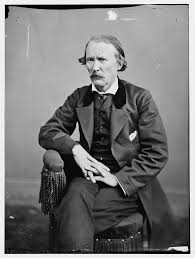
Chris1opher "'Kit" Carson, 1809-1868
What happened next is not entirely clear. Some sources say that Frémont ordered one of the men, Ben Kelsey, to shoot the Californians, but Kelsey, being a friend of Berryessa's, refused the order. Fremont then ordered Kit Carson to intercept the men. Other sources say that Kit Carson acted on his own initiative, but with Frémont's approval. ln any case, Kit Carson, Granville Swift, and another man walked down the mission steps, mounted their horses, and approached the three Californians. Seeing the armed Americans, Berryessa and the de Haro boys stopped. Carson determined that they were unarmed and went back to the mission to ask Frémont if he should take them prisoners.
"I have no need of prisoners," Fremont replied. "Mr. Carson, do your duty."
Carson returned to the three men standing in the dusty street, raised his rifle, and shot Ramon de Haro. His brother Francisco cried out and threw himself over his brother's body to shield it.
"Kill the other son of a bitch!" one of the Americans shouted. A second shot rang out and Francisco fell dead across his twin brother's body.
Horrified, Berryessa cried out to Carson, "Why have you killed these boys? You might as well shoot me, tool" In reply, Carson shot him in the head. The men searched and stripped the bodies and left them lying in the street 8. It is said that Indians later took the bodies away and buried them. Teenager Stephen Richardson, whose sister was engaged to Francisco de Haro, saw the shootings.
A few days later, Frémont 9 and his men crossed the bay and stormed the little fort at the presidio. The Mexican soldiers had fled at their approach, so the Americans spiked the cannon to make them unusable. They raised the American flag and claimed California for the United States. Looking out over the sparkling waters, Frémont was so impressed by the scene that he named the strait the Golden Gate.
At about the same time, Berryessa's son, José, still in prison in Sonoma, learned from a Bear flagger who spoke Spanish that his father had been killed at San Rafael. The man showed José his father's serape, which be had taken from the old man's body. José begged the man to give him the serape that he might return it to his mother as a memento of her husband, but the man reused. José asked Frémont to intercede for him, but Frémont refused as well. Finally, José offered to buy it from the man and paid twenty-five dollars-over five hundred dollars in today's money.
ln 1856, Frémont ran for president of the United States. But Jose de los Santos Berryessa published a letter 10 accusing him of the cold-blooded murder of his father and the De Haro boys. Frémont claimed that the Californians were spies for General Castro and were carrying secret messages. But a witness to the killing, surveyor Jasper O'Farrell, wrote a letter 11 testifying to the truth of Berryessa's account of the murder. Both letters were widely published across the country, 12 and Frémont lost in a landslide to James Buchanan. The Berryessa and De Haro families eventually lost their land to the Americans. The Americans killed three more Berryessa sons; one shot in his bed, two others lynched. There are streets in San Francisco named for De Haro and O'Farrell, and in 2015 President Obama created the 330,000 acre Berryessa - Snow Mountain National Monument.
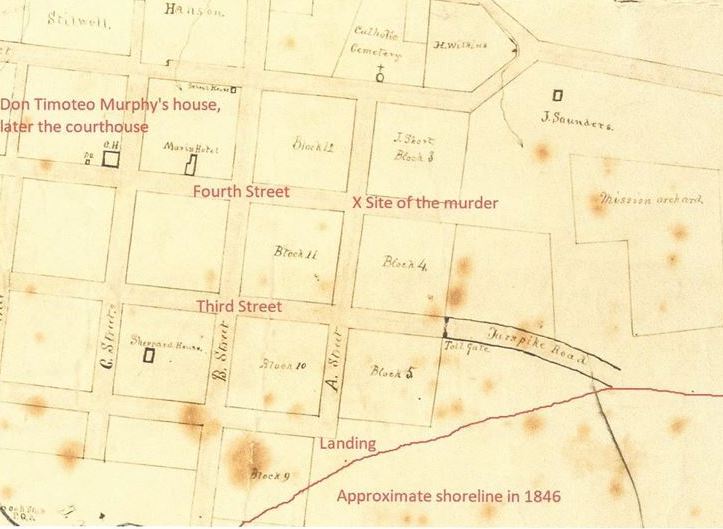
Map of downtown San Rafael made in April 1867 by County Surveyor Hiram Austin.
Courtesy of the Anne T. Kent California Room of the Marin County Free Library.
1. John Charles Fremont (1813-1890), illegitimate son of a Virginia planter, explorer, surveyor, military officer, first Republican candidate for President.
2. William L. Todd (1818-1876), designer of the Bear Flag, was a nephew of Mary Todd, wife of Abraham Lincoln.
3. Frémont had asked Captain William D. Phelps of the American bark Moscow, then lying at Sausalito, to prepare a large launch to get his troops across the strait to Yerba Buena. Phelps did so, anchoring his launch well offshore and filling it with food and supplies. Since no other boats were in Sausalito, he felt this was safe and left it unguarded. During the night, some Mexicans rowed a small rowboat across from Yerba Buena and made contact with de la Torre who used the rowboat to capture the launch and used it to transport bis men back to the presidio.
4. Northwest corner of 4th and C.
5. At 3rd and A Street, now the site of Kaiser Pemanente.
6. Now A Street.
7. Christopher Houston ·'Kit" Carson ( I809-1868), mountain man, guide, Indian fighter, and brevet Brigadier General in the Civil War.
8. Most likely at the intersection of Fourth and A Streets, now the corner of Courthouse Square.
9. Captain Phelps went to see Fremont in his Sausalito camp but did not see anyone who looked like an officer, so he inquired of one of the men: "He looked and pointed out a slender-made, well-proportioned man sitting in front of a tent .... A few minutes' conversation convinced me that I stood in the presence of the King of the Rocky Mountains."
10. "ln reply to your question whether it is certain or not that Col. Fremont consented to or permitted his soldiers to commit any crime or outrage on the frontier of Sonoma or San Rafael in the year 1846 .... Unfortunately Col. Fremont was walking in the corridor of the mission with some of his soldiers and they perceived the three Californians. They took their arms and mounted-approached towards them, and fired. Jt is perhaps true that they were scarcely dead when they were stripped of the clothing, which was all they had on their persons; others say that Col. Fremont was asked whether they should be taken prisoners or killed and that he replied that he had no room for prisoners and in consequence of this they were slain ..... "
11. "I was at San Rafael in June 1846 when the then Captain Fremont arrived at that mission with his troops .... They then advanced to within fifty yards of the three unfortunate and unarmed Californians, alighted from their horses, and deliberately shot them. One of them was an old and respected Californian, Don Jose R. Berryessa, whose son was the alcaldc of Sonoma. The other two were twin brothers and sons of Don Francisco de Haro, a citizen of the Pueblo ofYerba Buena. I saw Carson some two years ago and spoke to him of this act and he assured me that then and since he regretted to be compelled to shoot those men, but Fremont was bloodthirsty enough to order otherwise, and he further remarked rhat it was not the only brutal act he was compelled to commit while under his command .... (Signed) Jasper O'Farrell.
12. Though only one copy of one paper (Los Angeles Star, 27 September 1856) survives. Several historians believe the Fremont election campaign organized an effort to destroy all copies of the newspapers containing the letters.