
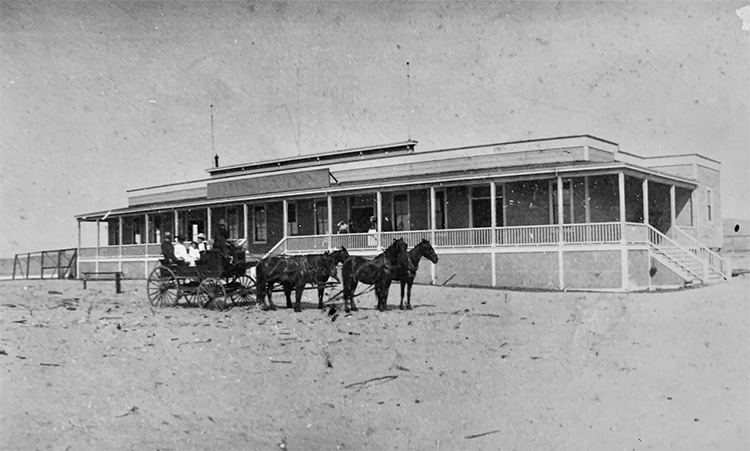

Before the present-day Marin coastal town took the name Stinson Beach, it was known as Willow Camp. Nathan Stinson and his wife, Rose, built the tent settlement in the early 1880s offering Bay Area campers and vacationers rustic canvas accommodations within easy walking distance of the beach and trails of Mt. Tamalpais. By the late 1890s, popularity of the camp increased when trains running on the newly constructed Mill Valley & Mt. Tamalpais Scenic Railway connected with the old stagecoach road at West Point Inn that ran down to Willow Camp and Bolinas. In 1904, The Dipsea Inn was built on the sand bar that protects Bolinas Lagoon by William Neumann on land owned by William Kent and Sydney B. Cushing. Both were stockholders in the Mill Valley & Mt. Tamalpais Railroad and owners of land in Marin along with many other business interests. Neumann was the first proprietor and part owner of the Inn.
But why Dipsea, you may wonder? The name of the hotel predates the famous Mill Valley to Stinson Beach cross-country race that officially began the following year. Alternative theories about the origin of the name have postulated that, 1) Willow Camp vacationers often enjoyed a ‘dip in the sea’, or 2) the rather steep stagecoach road to Willow Camp took a somewhat treacherous ‘dip to the sea’ as it descended from the summit of the mountain. However, in a 1924 letter from William Kent to N. L. Fitzhenry, the unofficial ‘mayor’ of Stinson Beach, coastal Marin promoter, and one-time owner of the beach, Kent claims to have adopted the name from a Rudyard Kipling poem, “The Last Chantey.” According to Kent it is an abbreviation for ‘deep sea’, and he liked the idea that it also encouraged visitors to take a “dip in the sea.” The name predates the race as advertisements for the Dipsea Inn and Hotel began appearing in Bay Area newspapers in 1904 promoting, “Surf Bathing---Summer or Winter”, “New Modern Hotel with Up-to-Date Management and an Excellent Kitchen, On Famous Bolinas Beach.”1
The 125-year-old Dipsea race had its origins in a bet made by two San Francisco Olympic Club members soon after the Inn had opened. Alfons Coney and Charles Boas, both avid hikers and frequent guests at the Inn, raced against each other from downtown Mill Valley to the Dipsea Inn with Coney being declared the winner. The following year, Coney, Boas and other Olympic Club members organized and ran the first official Dipsea Race with 84 contestants competing. A local high school runner, J.G. Hassard crossed the finish line first benefitting from a 10-minute handicap, while the fastest time belonged to C. Connolly, a champion miler from Ireland.
In 1906, the year our photograph was taken, Willow Camp and the Dipsea Inn were both used as refugee sites for victims of the great San Francisco Earthquake and Fire of April 18. Two of those refugees, Henry & Elizabeth Airey opened a competing hotel and restaurant in the area and seven years later, Henry’s brother, Jack and his wife Sarah, open another establishment, The Sea Beach Hotel. Within a few years as hotels become the preferred accommodation, Willow Camp was closed and the name of the town was changed to Stinson Beach, in honor of the founding family. The Dipsea Inn was torn down in 1918 and much of its timber was used to build the newer and bigger Dipsea Lodge, leaving behind the legacy of a name which now graces the oldest cross-country race in the United States.
Thank you to Dewey Livingston for forwarding me the Kent letter which is preserved in the Anne T. Kent, California Room of the Marin County Public Library.
(Originally appeared as History Watch article in the Marin Independent Journal)
For more background information see our online catalog!