
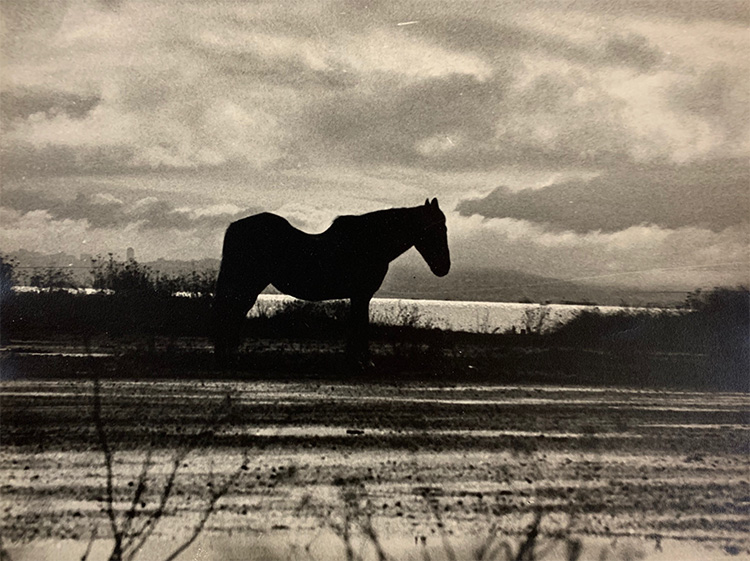

Most Marinites will easily recognize the swaybacked horse in this beautiful photograph and the location.
“Of course,” you say, “It’s Blackie standing out in his pasture overlooking Richardson Bay.” He has
become such a Marin icon that many folks, and I include myself, believe that they remember seeing him
as they drove past Trestle Glen Boulevard on the way to Tiburon. However, Blackie died in 1966, so the
math just won’t work for those of us who have not been a county resident for at least 55 years.
According to a 1964 Marin IJ interview with one of his owners, Anthony L. O’Connell (or Connell
depending on which article you read), Blackie was brought to California in 1926 (or 1927) from Kansas
(or Arkansas) by his brother John as a young cutting horse that worked the rodeo circuit in Northern California. Anthony, much like Daniel Peggotty in David Copperfield, lived in a converted houseboat on a cove of Richardson Bay having moved there in 1904 raising and selling clams for nearly 40 years. Blackie was put out to pasture by the brothers around 1938 and became the beloved, solitary sentinel to several generations of travelers and residents of the peninsula. Children who grew up in the area remember feeding him apples and carrots and virtually every peninsula resident grew to associate Blackie with their town, their neighborhood, and the less hectic days of the early 20th century.
(or Arkansas) by his brother John as a young cutting horse that worked the rodeo circuit in Northern California. Anthony, much like Daniel Peggotty in David Copperfield, lived in a converted houseboat on a cove of Richardson Bay having moved there in 1904 raising and selling clams for nearly 40 years. Blackie was put out to pasture by the brothers around 1938 and became the beloved, solitary sentinel to several generations of travelers and residents of the peninsula. Children who grew up in the area remember feeding him apples and carrots and virtually every peninsula resident grew to associate Blackie with their town, their neighborhood, and the less hectic days of the early 20th century.
That connection to the past took center stage in 1965 after the train ‘trestles” at Trestle Glen Blvd. were
torn down and the Tiburon Town Council approved a widening and re-routing of Tiburon Blvd. The
original design for the new highway was to pass right through the middle of Blackie’s Pasture, but the
local residents would have none of that. The Council was pressured to preserve part of the pasture and
leave Blackie in peace. Blackie and John O’Connell were even invited to the November 1965 ribboncutting
ceremony for the dedication of the new roadway. But Blackie, true to his nature, refused to cut
the ribbon as urged and just stood there; staring straight ahead. Blackie went back to his pasture
somewhat of a local hero.
John O’Connell died a few weeks later, but Anthony, who had been looking after the horse from his
nearby ‘beach house’ continued to watch over Blackie. On February 26th, 1966 Blackie collapsed while
standing in “his” spot and couldn’t be helped back onto his feet. A local veterinarian was called and
administered shots to ease the horses suffering and Blackie was humanely put to sleep the following
day. Burying a horse is no easy task and requests were made to inter Blackie in his bayside pasture
even though it would violate County health laws. The efforts were successful, however, when the Marin
County Health Department approved his burial where he had stood for so long. A small white picket
Blackie by Scott Fletcher
fence was erected around his grave and a brass plaque installed soon after, telling the story of Blackie
and his life. In 1995, the Tiburon Peninsula Foundation, with a gift from the family of Tiburon’s first
mayor, Gordon Strawbridge, erected a life-sized sculpture of Blackie, by Bay Area artist Albert Guibara.
in Blackie’s Pasture. Now that is something nearly every one of us has seen and enjoyed!
(Originally appeared as History Watch article in the Marin Independent Journal)