
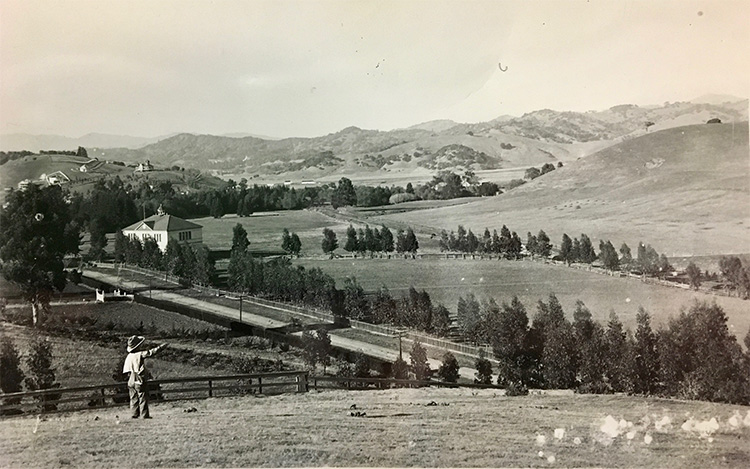

Few photographs capture the beautiful, pastoral landscape of early Marin like the one above.
Taken from just above present day Corte Madera and Magnolia Avenues, a young boy points
northeast into the distance, at what we don’t know, though the spectacular panorama was
obviously of great interest both to the boy and the unknown photographer.
The Old Corte Madera School, now the site of Marin Primary and Middle School is seen to the boy’s
left. Early settlers Frank Pixley and Agnes Forbes had donated the land for the school in 1894. Ten
years earlier, Pixley had been granted a deed to 160 acres of John Reed’s Corte Madera Del
Presidio, literally, “cut wood of the Presidio” by Reed’s daughter, Hilarita. Only a few homes dot the
landscape in the hills above present-day Larkspur and the North Coast Pacific Railroad tracks can
be seen running off into the background on the right of the image. The railroad ran from Sausalito
through Corte Madera (the station was at today’s Menke Park) north to San Rafael, then Pt. Reyes,
Tomales and eventually Cazadero in Sonoma County. Pixley’s children eventually developed the
barren hillside to the right for housing and it is now the Baltimore Park neighborhood overlooking
both Larkspur and Corte Madera.
At the time the photograph was taken much of the area had been converted to farming and
ranching after the timber industry had felled most of the trees that once flourished on the foothills
of Mt. Tamalpais. There was a moderate influx of new residents after the 1906 earthquake and
both Corte Madera and Larkspur incorporated in the first decade of the 20th century. The Old
Schoolhouse sits on the spot where the two city limits meet. Population growth was slow until
World War II when the Sausalito shipyards brought thousands of workers and their families to
Marin. By the 1950s and 1960s housing subdivisions and shopping malls were springing up all
over central and southern Marin and the bucolic landscapes of the past were transformed forever.
(Originally appeared as History Watch article in the Marin Independent Journal)